

Subtotal $0.00

House construction is certainly the biggest expenditure of life. Nevertheless, most of the homeowners pay attention to the paint, the kitchen, or the interior design, and they forget that it starts with one and the most important decision: the foundation. Concrete slab foundation has become the most preferred, sustainable, and economically viable construction choice of all construction varieties in 2026 as far as residential and commercial construction is concerned.
Be it a small backyard garage, a strong workshop or a luxurious upscale villa, a profound knowledge of a slab-on-grade foundation would be crucial to the long-term structural integrity. We are not simply offering assistance at Noor Foundation in growing the community; we are also empowering our community to make the right decisions about their most valuable things through technical knowledge.
Our mission is to help you develop a Self-Sustaining Cycle of security and growth, starting from the very ground you stand on.
What Exactly is a Concrete Slab Foundation?
In professional engineering terms, builders create a concrete slab foundation (also known as slab-on-grade) by pouring a 4 to 6-inch thick layer of concrete directly over a carefully prepared base of gravel and soil. Unlike traditional basements or crawl spaces, there is no hollow space under the floor. This solid structure offers immense durability, thermal mass, and a natural shield against pests like termites.
The anatomical elements of a high-quality slab include:
- Subgrade: This is the native soil layer. It must be cleared of all organic debris and heavily compacted to form the primary support.
- Base Course: A layer of crushed gravel or stone (usually 4-6 inches) that facilitates essential drainage and prevents “wicking” of moisture.
- Vapor Barrier: A heavy-duty plastic sheet (polyethylene) that stops water vapor from migrating into the concrete, which is the number one cause of under-slab mold.
- Reinforcement: Steel rebar or welded wire mesh. This provides the concrete with the tensile strength needed to resist cracking under the weight of the structure.
2026 Cost Analysis: Strategic Budgeting for Construction
While market prices for cement and steel fluctuate due to global supply chain shifts, the logic behind smart construction remains the same: investing in high-grade materials today saves tens of thousands of dollars in future structural repairs.
| Foundation Element | Average Cost per Sq. Ft. (2026) | Professional Tip |
| Basic Material & Pour | $6.00 – $13.00 | Always use 3,500+ PSI mix for better weight distribution. |
| Site Preparation | $2.00 – $4.00 | Professional grading is the only way to avoid water pooling. |
| Reinforcement (Rebar) | $0.70 – $1.80 | Use #4 rebar for driveways or heavy-load garage areas. |
| Vapor Barrier & Sealants | $0.25 – $0.60 | High-density barriers are essential for healthy indoor air. |
Total Estimated Investment: For a standard 2,000 sq. ft. Modern Residential Home, expect a total investment of $14,000 to $30,000. Strategic budgeting and high-quality materials ensure that the foundation remains a one-time investment rather than a recurring repair cost.
Choosing the Right Type: Which Slab Do You Require?
Not all slabs are created equal. Your choice must be based on your local climate, the specific soil compaction levels of your land, and the total load the building will carry.
1. Monolithic Slab (The Efficiency King)
Workers pour the footing (thickened edges) and the main slab together in one continuous process in this method.
- Pros: It is the fastest to build and very economical since it consumes a lot of less labor.
- Cons: It cannot be used in flood-prone areas and in the regions where the frost line is very deep.
2. Stem Wall Slab (The Cold Climate Solution)
Builders complete this work in a multi-step process. They first lay a concrete footer. Then they build a masonry or concrete wall. Finally, they pour the slab in between.
- Merits: It provides incredible stability in northern regions. Always check the International Residential Code (IRC) for specific footer depth requirements in your county to ensure you are up to code.
3. Floating Slab (The Versatile Choice)
A floating slab is intended to move as a single unit over the soil. It doesn’t have deep footings, making it “float” on the ground.
- Best For: Unattached buildings like garages, sheds, or workshops where the ground might be unstable.
Thorough Step-by-Step Construction Protocol
To ensure your home stands the test of time, the construction must follow a strict, professional protocol that mirrors high-quality engineering standards.
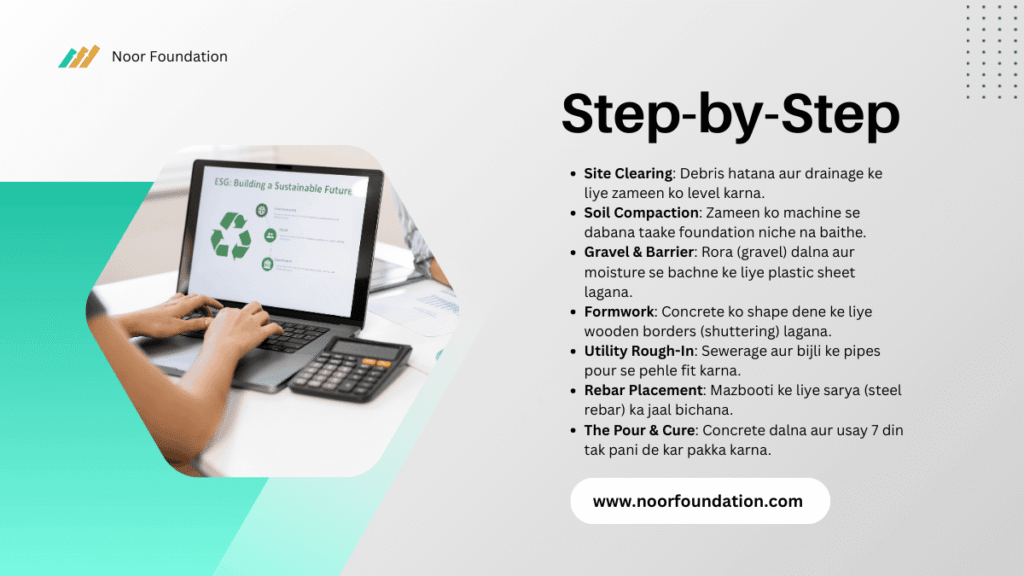
- Site Evaluation & Grading: This involves clearing all vegetation and leveling the land. Accuracy is key; even a 1-inch error in grading can cause major drainage issues for years.
- Professional Soil Testing (Crucial Step): Before any work begins, a soil report is essential to determine the load-bearing capacity. This ensures the foundation design matches the specific ground conditions of your site.
- Soil Compaction: Using “jumping jacks” or heavy-duty plate compactors, the soil density is increased. This prevents the earth from shifting or settling under the weight of the slab.
- Forming & Layout: Wooden frames (forms) are installed to define the perimeter. This stage provides the first physical outline of the structure’s footprint.
- Utility Rough-In: This is the most critical stage. Workers install all plumbing and electrical conduits now. Remember: Once they pour the concrete, relocating a pipe becomes an expensive and near-impossible task.
- Reinforcement Placement: A grid of steel rebar (typically #4) is placed to provide tensile strength. This reinforcement allows the concrete to resist cracking during extreme temperature changes.
- The Pour & Vibration: Workers pump concrete into the forms and use mechanical vibrators during the pour to remove trapped air bubbles, preventing honeycombing or internal weak spots.
- Finishing & Controlled Curing: Workers trowel the surface to a smooth finish and keep the slab moist (curing) for 7 to 14 days to reach maximum design strength. Skipping this step leads to surface cracks and structural weakness.
General Problems and Preventative Maintenance
Even the strongest concrete slab foundation can be threatened by nature. Homeowners must stay vigilant to identify problems early.
- Settlement Cracks: Usually result from poor initial soil preparation or extreme drought followed by heavy rain.
- Hydrostatic Pressure: This occurs when water accumulates around the foundation and presses against the slab, causing it to “heave” or lift upwards.
- Plumbing Leaks: If a pipe breaks under a slab, it can cause the soil to wash away, leading to a “void” and eventually a collapsed floor.
How to Prevent Foundation Damage:
Make sure you slope the ground at a 2% grade away from the house. Direct your downspouts to discharge water at least 10 feet away. To ensure your foundation meets safety standards, always cross-reference your project with the International Residential Code (IRC) or consult with a licensed structural engineer.
Noor Foundation’s Vision: Stability Beyond Construction
At Noor Foundation, we advocate for resilience in every aspect of life. Just as a building needs a solid concrete base, a community needs a strong foundation of resources and technical knowledge. By investing in local development and professional skills, such as modern construction techniques, modern construction engineering and vocational skills, we create an environment that is not dependent on external economic shifts.
We believe in the Self-Sustaining Cycle: once a person builds a stable home and a stable career, they have the capacity to help the next person do the same. This is the “Foundation of Success” that we are building together.
Final Recommendation: Building for the Future
A solid concrete slab is the backbone of your home’s structural integrity. It also offers the heating and cooling comfort, the pest protection, and the construction tranquility that every family should have. By making the right kind, by reinforcing it correctly, and by being concerned in good quality work at curing, you are not just making a house, but you are making a stable heritage that will provide for the generations to come.

