

Subtotal $0.00

When seeking capital for international business ventures or massive real estate developments, the traditional banking system often falls short. In 2026, the shift toward non-traditional, asset-based lending has reached an all-time high. However, with great opportunity comes great risk. Search phrases like “Kennedy Funding Ripoff Report” are common, reflecting a deep-seated anxiety among borrowers who feel caught in the “fee trap.”
But is every “Non-refundable due diligence fees” a sign of a scam? Or is it a symptom of a fundamental misunderstanding of how high-finance underwriting works? At Noor Foundation, our mission is Awareness and Support. We believe that the only way to protect your vision is through absolute transparency and a solid financial foundation.
The Anatomy of a “Ripoff Report” – Perception vs. Reality
A “Non-refundable due diligence fees” is often the result of a deal that failed at the eleventh hour. In private lending, specifically with firms like high-Finance Institutions, complaints usually center on non-refundable Commitment Fees and Due Diligence Deposits.
The Core Conflict:
Borrowers often enter these deals under the impression that a Letter of Intent (LOI) is a guaranteed promise of a loan. In reality, an LOI is merely a “handshake” to begin the investigation.
- The Valuation Gap: A borrower might believe their property is worth $20M. However, an international valuation audit might reveal a “distressed” value of only $12M.
- The Cost of Truth: The lender spends thousands on third-party professionals. According to the Investopedia Guide on Due Diligence, these costs are mandatory for risk assessment and are typically borne by the borrower. When the loan is declined based on the audit, the borrower loses their deposit, leading to a “High-stakes private lenders.”
The “Iron Hull” of Your Financial Security
At Noor Foundation, we compare your business to an ocean-crossing ship. The Hull is what keeps you afloat in stormy weather. If the hull is thin, even a small legal or financial wave can sink you.
Your Self-Sustaining Cycle is your ship’s hull. The best way to safeguard yourself against predatory lending or failed bridge loans is to build internal resilience. By plowing profits back into your own operations, a principle we call Modern Philanthropy in business, you build an “Iron Hull.” When you approach a lender from a position of strength rather than desperation, you have the power to negotiate or walk away. Desperation is a leak in your hull; avoid it at all costs.
How Professional Private Underwriting Works in 2026
To succeed, you must think like a lender. Private bridge lenders are 100% asset-based. They are not interested in your personal credit score; they are interested in the liquidation value of your collateral.
The 2026 Due Diligence Roadmap:
- Stage 1: The Preliminary Filter: Lenders quickly assess if the asset (e.g., a hotel in Dubai or a warehouse in London) fits their risk profile.
- Stage 2: The Retainer Agreement: Once you sign the LOI, you pay a deposit. This money is “Gated”, it is only used to pay third-party professionals who work for the lender.
- Stage 3: The Hard-Asset Audit: This is where most deals fail. Inspectors look for structural issues, title liens, or environmental hazards.
- Stage 4: Final Investment Committee: The final decision is based on a “Loan-to-Value” (LTV) ratio. If the LTV is too high, the loan is rejected.
The True Cost of Capital – Private vs. Traditional
In 2026, the gap between bank rates and private bridge rates widened. Understanding the “Math of Risk” is essential for your financial health.
- Traditional Bank Loans (4%-7%): These require high credit scores, 3 years of tax returns, and massive paperwork. They take 3-6 months to close.
- Private Bridge Loans (11%-18%): These are fast (2-4 weeks) but expensive. The high interest rate is a “Risk Premium.” Lenders charge this because they are taking a chance on an asset that banks won’t touch.
Why the “Fee” is Non-Refundable:
Imagine hiring a private detective to investigate a crime. Whether the detective finds the criminal or not, you still have to pay for his time and travel. Lending due diligence is the same. The “High-stakes private lenders” often comes from people who don’t realize they are paying for the investigation, not the result.
Comparing Strategic Funding Models
Stability is built on choice. If a bridge loan feels too risky, look at these alternatives:
| Feature | Private Bridge Loans | Mezzanine Financing | In-House Financing |
| Primary Risk | Forfeiture of Fees | Loss of Equity | Slow Growth Pace |
| Capital Cost | High Interest | Equity Share | 0% Interest |
| Approval Speed | 2-4 Weeks | 4-8 Weeks | Organic |
| Repayment | Bullet Payment | Cash Flow Share | None |
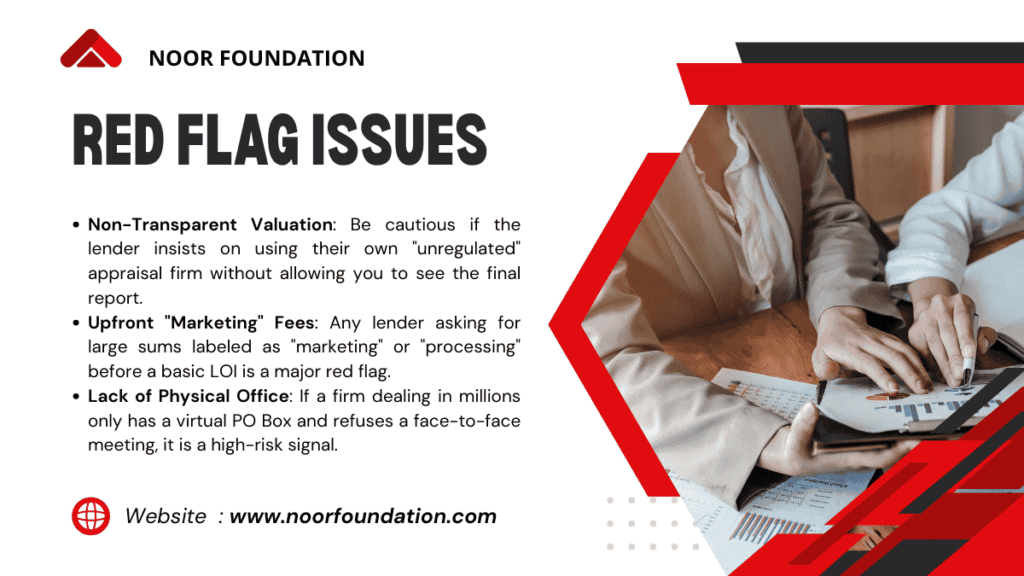
Advanced Exit Strategies – How to Repay the Debt
A bridge loan is a bridge to somewhere. If you don’t have a destination, you will fall off the bridge. In 2026, professional borrowers use these 5 exit strategies:
- Traditional Refinance: Moving from an 18% bridge loan to a 6% bank loan once the property is stabilized.
- Asset Sale: Developing the land and selling it to pay off the lender.
- Cash Flow Coverage: Using the income generated by the business to pay back the principal.
- Institutional Buy-out: Finding a private equity firm to take over the debt.
- Gating Fund Liquidation: Using reserved internal capital to settle the balance.
Geopolitical Risks & AI Auditing in 2026
The global lending market is now influenced by AI-driven risk models. In 2026, lenders will use “Sentiment Analysis” to check your online reputation.
Pro-Tip: If you have a legal dispute, it will show up in their AI scan. Be transparent from Day 1. We also recommend using AI-based contract auditors to scan your loan documents. Specifically, look for “Default Interest Rate” and “Premium Load” clauses that can turn a 12% loan into a 24% nightmare overnight.
Real-World Case Study – Success vs. Dispute
Case A: The Prepared Developer (Success)
A developer seeking $10M for a resort spent $15,000 on an independent, “White-Label” appraisal before contacting a lender. He presented a 100% accurate report. The lender’s due diligence only confirmed what the developer already knew. The loan closed in 22 days because his “Hull” was watertight.
Case B: The Optimistic Founder (The Ripoff Scenario)
A founder with a “ground-breaking” industrial site paid a $40,000 due diligence deposit based on his own “estimation” of the value. When the lender’s professional audit found significant soil contamination, the loan was refused. The $40,000 was gone. Feeling “robbed,” the founder posted a Kennedy Funding Ripoff Report.
Your 2026 Borrowing Checklist
- Independent Valuation: Get an MAI-certified appraisal before you pay any lender fees.
- Verified Exit Strategy: How will you pay this back? If you don’t have a bank lined up, you are gambling.
- Lender Reputation Audit: Don’t just read one report—look for patterns. Are the complaints about the same thing?
- Operational Reserve: Never use your last dollar to pay a due diligence fee. Maintain a “Gating Fund” to keep your business alive if the deal fails.
Knowledge is the Only Real Capital
The world of private equity is not for the faint of heart. Whether we are discussing infrastructure or real estate, the conclusion is the same: Knowledge is the only real Capital. By mastering the “Growth Navigate Funding” system and committing to a Self-Sustaining Cycle, you ensure that your business will endure, no matter how the political or lending climate changes. Is here to provide the figures, the facts, and the transparency you need to win in 2026.
Mandatory Financial & Legal Disclaimer
Disclaimer: The information provided in this article is for educational and awareness purposes only and does not constitute legal or financial advice. Noor Foundation is not a financial advisory firm, a law firm, or a lending institution. We strongly recommend consulting with a licensed professional before signing any agreements.

