

Subtotal $0.00

As we move further into 2026, the debate on Artificial Intelligence worldwide has moved beyond the automation aspect. It now focuses on “Alignment” ensuring machine intelligence serves human and ethical needs, including the welfare of the community. The first initiative in this movement is the People-First AI Fund, a monumental project aimed at supporting people who use AI to benefit humanity.
Among nonprofit leaders, community organizers, and tech-to-good innovators, this fund is a unicorn, an opportunity to get unlimited funds. We will cover everything, from the gist of the entire fund to the nitty-gritty of the application cycle of 2026, so that you have the guidelines to achieve success.
What is a People-First AI Fund?
An example is The People-First AI Fund, a strategic program primarily supported by a $50 million contribution from OpenAI, that helps organizations with two key focuses: AI innovation and social impact. This fund focuses on Return on Society rather than Return on Investment (ROI), unlike traditional tech investments.
The mission is focused; it should be guaranteed that the Intelligence Age is not built on, but with, and with communities, so that they direct it. By 2026, the fund will have grown, targeting organizations that are frequently targeted by Silicon Valley, such as rural nonprofits, linguistically isolated communities, and elderly-centered care institutions.
The 2026 Funding Cycle Core Pillars
To succeed with your application, your project must fit into one of the four strategic pillars developed in the 2026 cycle. These pillars are the most pressing needs of our world society:
1. Artificial Intelligence Literacy and Social Perception
The digital divide is no longer merely about access to the internet; it is also about access to understanding. The fund funds initiatives which:
- Train Local Leaders: Preparing educators, religious leaders and artists with real-world AI.
- Media Campaigns: Developing the content that would demystify AI among the general population.
- Hands-On Skills: Assistance of individuals to make use of AI tools to enhance their lives and employment safety.
2. Community-Led Innovation
This pillar is concerning Place-Based settings. The fund seeks to deploy AI tools in schools, libraries, clinics, and community centers. The idea is to have AI co-created with the dwellers who will act as real users, especially young and marginalized groups.
3. Fair Work and Economic Opportunity
The People-First AI Fund puts its money in the tools that:
- Maximize Human capability: Artificial intelligence that complements employees instead of displacing them.
- Small Business Growth: Assistance to local entrepreneurs in taking advantage of AI to expand their business.
- Career Resilience: Resources that help individuals find alternative careers after being laid off in the distressed sectors.
4. Medical Accessibility and Confidence
Healthcare is also a priority. In 2026, the fund is particularly seeking:
- Empathetic Diagnostics: Predicting health risks earlier in rural doctors using AI.
- Mental health assistance: Ethical and secure AI-based support in underserved populations.
- Linguistic Diversity: AI models that work under local lingo so that all can receive medical information.
Detailed Eligibility Requirements for 2026
Understanding eligibility is the most critical part of the process. Many organizations spend weeks on a proposal only to find they don’t meet the baseline criteria.
| Criterion | Specific Requirement |
| Legal Status | Must be a U.S.-based public charity with valid 501(c)(3) status. |
| Location | Must operate primarily within the 50 U.S. states or District of Columbia. |
| Annual Budget | Must be between $500,000 and $10 million. |
| Previous AI Experience | Not Required. Newcomers and explorers are encouraged to apply. |
| Submission Limit | Only one application per organization is permitted. |
The 2026 Application Roadmap: Step-by-Step
The 2026 cycle must be intensive but user-friendly. The sure way to a successful submission is as follows:
Phase 1: Pre-Application/Listening
Talk to your target community before writing your proposal. The People-First AI Fund appreciates Listening Sessions. Write down what your community needs for technology.
Phase 2: The Web-based Grant Portal
Create an account on the official OpenAI or partner portal. You will be required to provide your EIN (Employer Identification Number) and your organization’s basic financial history.
Phase 3: The Concept Note
This is your primary pitch. Within about 1,000- 1,500 words, you need to describe:
- The particular problem in the community that you are solving.
- The way AI offers a solution that other tools don’t.
- Your data privacy and ethical implementation plan.
Phase 4: Technological-Ethical Approach
Shortlisted candidates will be subject to review by a nonprofit commission. They will assess bias in your suggested AI models and ensure that your project adheres to the Human-Rights in Tech model.
Phase 5: Final Selections and Unlimited Funding
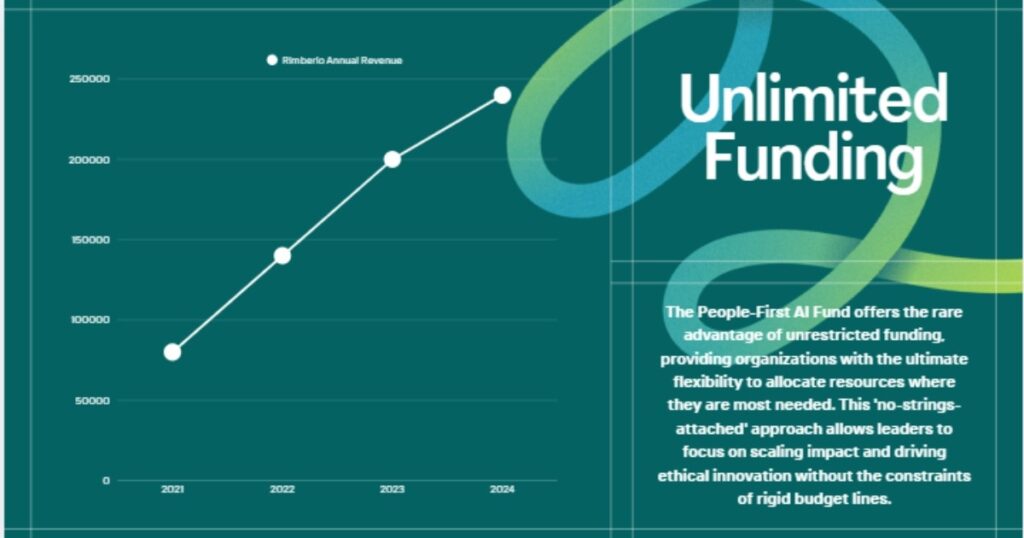
The peculiarity of this fund is that the grants are not limited. This implies that should you be chosen, you have the discretion and latitude to use the money where it is likely to do the most good- be it in recruiting talent, purchasing equipment or doing more research in the community.
Why People-First AI is the Future
In recent years, AI has been regarded as a top-down technology. Megabanks created models and informed the world on how to utilize them. This model is inverted in the People-First AI Fund 2026. It is a “bottom-up” approach.
The fund supports the development of AI on a wide range of datasets that incorporate real-life linguistic, cultural, and economic diversity by funding local nonprofits. This simplifies the technology, making it more accurate and beneficial to all.
Case Study: Influence on International Development
Although the fund is presently concentrated in the U.S., it operates globally. By early 2026, partners such as the Tata Group in India had similar missions: to enable AI for the last person on Earth. International NGOs frequently use the methodologies developed by the grantees of the People-First AI Fund as models.
Common Pitfalls: How to Avoid Rejection
- Over-Complication: Please, do not resort to heavy technical language. When a community leader fails to comprehend your proposal, then it is not People-First.
- Casual Attitude to Privacy: The project, which lacks a precise data security plan, is of concern.
- Sustainability Gaps: Be specific regarding the continuity of your project after the grant terminates.
Shaping the Intelligence Age
The People-First AI Fund 2026 is more than just a financial resource; it is a call to lead. It is a challenge to the tech world to prove that innovation can be both cutting-edge and deeply human. By aligning your organization’s mission with these values, you are doing more than just applying for a grant; you are helping to build a future where technology amplifies human potential rather than replacing it.

