

Subtotal $0.00


The nature of global justice is changing rapidly. In 2026, the conservative modes of legal reform are barred by more energetic, technologically sophisticated, and people-oriented modes of reform. The USAID Judicial Reform strategy is at the core of this revolution – a colossal international project to make the so-called Rule of Law not merely a postulate of a high level, but a reality that every citizen is obliged to live by.
For an organization such as Noor Foundation, understanding these strategic changes is important. Whether you are learning how to start a nonprofit or you are a legal expert, this guide will provide everything you need to know about the USAID’s judicial roadmap for 2026.
What is USAID Judicial Reform?
In its most basic sense, judicial reform refers to improving a country’s legal system. Under the 2026 USAID mandate, however, it is much deeper. It is no longer about constructing courthouses or training judges, but about systemic resilience.
The basic aim of USAID’s Judicial Reform is to promote independence, accountability, and efficiency. In most developing countries, the judicial system tends to get entangled in political interference or manual systems. USAID intervenes to provide the technical know-how and funds necessary to modernize such systems.
The Three Pillars of Reform in the Modern World:
- Independence: This is necessary to ensure that judges can make decisions grounded in law rather than politics.
- Accountability: Establishing mechanisms that will monitor judicial corruption.
- Efficiency: This is needed to reduce the years-old backlog of cases that deprives people of justice.
Key Pillars of USAID’s 2026 Strategy
In 2010, the USAID introduced a strategic pivot targeting three key areas. When you are writing or researching on this, the following are the “buzzwords” that Google would be searching for:
1. People-Centered Justice (PCJ)
The most significant change is the shift to People-Centered Justice (PCJ). Rather than examining justice from top to bottom, USAID is examining it in a bottom-up manner—fixing land disputes, family law, or small business obstacles that people face daily.
2. Anti-Corruption/Judicial Checks and Balances
Development is the antagonist of corruption. In 2026, USAID allocated more funding to Internal Oversight Bodies within the judicial councils. They are complicating the ability of dirty money to skew the scales of justice by using data analytics to identify suspicious patterns in sentencing or case assignment.
3. E-Justice (digital transformation)
It is 2026, and paper files are phasing out. USAID is investing heavily in Integrated Case Management Systems (ICMS). On these digital platforms, there is the possibility of:
- Electronic filing of cases.
- Computerized hearing schedules.
- Transparency through access to court records to the population.
The USAID in the Global Legal Empowerment
USAID relies on collaborations with local NGOs and organizations like Noor Foundation. By empowering local actors, reforms become culturally relevant. This is a key part of our mission in active support against poverty, as a fair legal system is the only way to protect the rights of the underprivileged.
Strengthening the Rule of Law
A stable economy is dependent on the Rule of Law. It is difficult to draw investors into a market that does not enforce contracts or has an unreliable legal system. The USAID indirectly enhances global economic growth by stabilizing the judiciary. In 2026, there is a direct correlation between the USAID-supported legal reforms and the Foreign Direct Investment (FDI) into the partner nations.
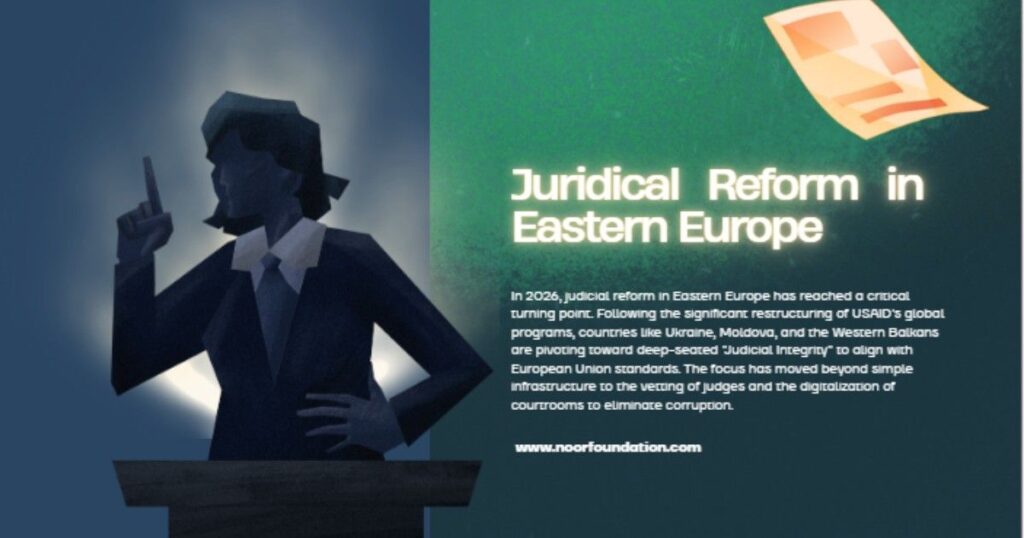
Juridical Reform in Eastern Europe & Eurasia
USAID is targeting Judicial Integrity in areas under high geopolitical pressure. This includes screening judges on the history of corruption and ensuring that the executive does not overstep the Supreme Court’s of these countries.
Currently, African Legal Frameworks are being strengthened
In most African countries, the 2026 priority is “Access to Justice.” This involves the use of mobile courts that move to rural regions, providing access to the USAID-funded legal system for residents who may not afford to travel to the capital city.
Difficulties in effecting USAID Judicial Reform
It’s not all smooth sailing. Despite the billions of funds, there are several Roadblocks left:
- Political Will: The ruling elites benefit from a weak judiciary. The most difficult aspect of the job is to win their cooperation.
- Digital Divide: Although the idea of e-Justice is excellent, not all rural regions have the skills or internet access to facilitate it.
- Cultural Resistance: In certain areas, traditional or tribal forms of justice are incompatible with state laws.
The Future of Justice: AI and Ethics in 2026
It is impossible to discuss USAID Judicial Reform in 2026 without mentioning Artificial Intelligence. One of the examples of AI tools that are under pilot testing by USAID can assist legal clerks with summarizing legal text in thousands of pages within a few seconds.
Nonetheless, they are also establishing rigid ethical standards. The point is to ensure that AI does not replace the human component of justice but instead supports the judge. Such a combination of technology and morality is what renders the 2026 strategy so distinctive.
How 2026 Reforms Differ from Previous Decades
If we compare the 2020 approach to the 2026 strategy, the difference is night and day.
| Feature | 2020 Approach | 2026 Strategic Guide |
| Primary Focus | Infrastructure & Training | People-Centered Justice (PCJ) |
| Technology | Basic Digitization | AI-Driven Case Analytics |
| Climate Focus | Minimal | High (Environmental Justice) |
| Implementation | International Experts | Local Works & Foundations |
The Impact in 2026: Measuring Success
Do we know whether USAID Judicial Reform is working? The specific Key Performance Indicators (KPIs) used by USAID are:
- Decrease in Case Backlog: It is expected that the case backlog will be reduced by 30 percent by 2026.
- Public Trust Index: Surveys made in partner nations to determine whether citizens believe that the courts are fair.
- Legal Aid Access: The number of poor individuals who access free or affordable legal assistance.
The Way Forward of Noor Foundation
On the way to the second half of 2026, the USAID Judicial Reform agenda is clear: Justice should be accessible, digital, and corruption-free. For the Noor Foundation, the ability to remain in line with these global standards will help create local impact.
Even though the process to the best legal system is a lengthy one, with the right strategic compass and global collaboration, the vision of “Justice for All” is coming true day by day.

